

About the Encanto-Palmcroft Historic District
Bounded by 7th Avenue and 15th Avenue, between McDowell Road and the northern edge of Encanto Park, the Encanto-Palmcroft Historic District stands as one of the most prestigious and visually spectacular historic neighborhoods in all of Central Phoenix. Developed primarily in the 1920s and 1930s, Encanto-Palmcroft represents the pinnacle of Period Revival residential architecture in Phoenix — a neighborhood conceived from the beginning as a grand address, and one that has never relinquished that distinction.
For buyers searching for Encanto-Palmcroft homes for sale, this is a district unlike any other in the Valley. Its palm-lined boulevards, oversized lots, architecturally distinguished residences, and direct adjacency to one of Phoenix’s most beloved urban parks combine to create a living environment that commands — and consistently sustains — premium values in the Central Phoenix real estate market.
History & Origins
The Encanto-Palmcroft neighborhood grew out of Phoenix’s most ambitious era of residential development. In the 1920s, as Phoenix was rapidly expanding and a prosperous merchant and professional class was looking for addresses that matched their ambitions, developers platted what would become Encanto-Palmcroft as a showcase community. The name itself reflects the vision: Encanto — Spanish for enchantment — and Palmcroft, a nod to the towering palms that were planted along its streets from the outset.
Construction proceeded briskly through the late 1920s, slowed during the Great Depression, and concluded in the early 1940s, giving the district a remarkably cohesive architectural character that reflects the very best of interwar American residential design. The homes that were built here were not modest starter houses — they were substantial residences commissioned by Phoenix’s civic leaders, business owners, and professional families who wanted architecture, permanence, and a setting befitting their status.
The Encanto-Palmcroft Historic District was formally recognized for its significance and is protected under the City of Phoenix historic preservation overlay, which governs exterior changes and ensures the district retains its visual integrity for future generations. That protection is one of the reasons Encanto-Palmcroft real estate holds its value so reliably — buyers and sellers alike can be confident that the neighborhood’s character is not subject to the whims of individual owners or speculative development.
Architectural Styles: Grand Period Revival at Its Finest
What sets the Encanto-Palmcroft Historic District Phoenix apart from nearly every other historic neighborhood in the Valley is the scale and quality of its architecture. These are not the modest bungalows or compact cottages found in many surrounding districts — the homes of Encanto-Palmcroft are substantial, carefully designed residences that showcase the full ambition of 1920s and 1930s Period Revival construction. The dominant styles include:
- Spanish Colonial Revival — The most prevalent and perhaps most celebrated style in Encanto-Palmcroft, these homes feature creamy stucco exteriors, red and barrel clay tile roofs, arched entryways and windows, wrought-iron hardware, and decorative tile work that draws on the Spanish Colonial tradition of the American Southwest. Many include interior courtyards, loggias, and outdoor living areas that feel perfectly suited to the Arizona climate and have aged magnificently over the decades.
- Tudor Revival — Steeply pitched rooflines, decorative half-timbering, leaded glass windows, and substantial masonry chimneys give these homes a deeply romantic Old English character. Encanto-Palmcroft’s Tudor examples tend to be larger and more elaborately detailed than those found in adjacent historic districts, reflecting the affluent clientele for whom they were built.
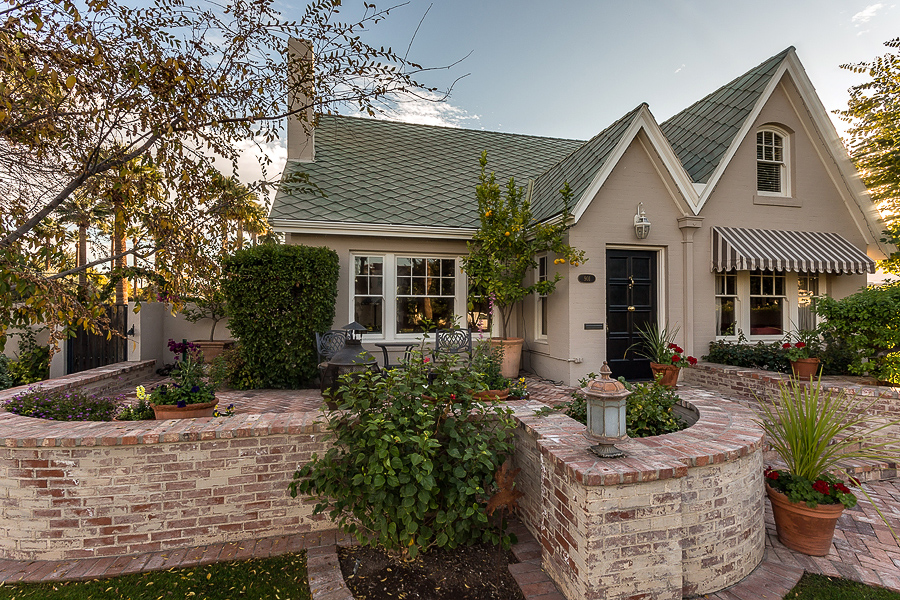
- English Cottage — A more intimate variation on the Tudor theme, English Cottage homes in Encanto-Palmcroft feature asymmetrical facades, steep gabled rooflines, and a storybook quality that makes them enduringly appealing. They sit beautifully against the backdrop of the district’s mature landscaping.
- Monterey Revival — Two-story homes with wooden balconies cantilevered over the front facade, often combining stucco and wood siding, the Monterey style represents the California-influenced thread of Period Revival design that found its way into Phoenix’s finest neighborhoods during this era.
- American Colonial Revival — Symmetrical, formal facades with columned entries, shuttered windows, and classically balanced compositions bring an East Coast elegance to the desert. These homes project quiet authority and have aged into their surroundings with grace.
- Ranch Style — A handful of later homes in the district reflect the mid-century Ranch aesthetic, offering single-story, sprawling floor plans that honor the ease of Arizona indoor-outdoor living.
Across all of these styles, the craftsmanship in Encanto-Palmcroft is exceptional. Original hardwood floors, plaster walls, hand-laid ceramic tile, vintage hardware, and custom millwork are common throughout the district. These are materials and methods that cannot be reproduced in new construction at any price point, and they give historic homes in Central Phoenix a tangible quality and warmth that buyers feel the moment they step inside.
The Palm-Lined Streets: An Iconic Phoenix Streetscape
If there is a single image that defines the Encanto-Palmcroft Historic District, it is the view down one of its grand boulevards — a double row of towering queen palms arching over a wide, sun-dappled street, with Period Revival facades visible behind lush front gardens on either side. The palm-lined streets of Encanto-Palmcroft are among the most photographed and most recognized residential streetscapes in Phoenix, and they are not accidental.
The original developers planted the palms with deliberate intention, understanding that a grand boulevard requires a grand frame. Over the ensuing century, those palms have grown to dramatic heights, transforming the streets of Encanto-Palmcroft into something that feels almost Mediterranean — a quality that surprises and delights first-time visitors and never loses its appeal for long-time residents.
These streets are wide by historic Phoenix standards, with generous setbacks that give each home room to breathe and that allow the landscaping to register as a genuine part of the composition. Front yards are typically larger than those found in neighboring districts, and many are professionally maintained with additional mature trees, flowering shrubs, hedges, and period-appropriate plantings that amplify the neighborhood’s atmosphere of cultivated elegance.
Encanto Park: 222 Acres of Urban Parkland at Your Doorstep
One of the defining advantages of living in the Encanto-Palmcroft Historic District is the neighborhood’s direct adjacency to Encanto Park — a 222-acre urban oasis that represents one of the most generous and complete public parks in Phoenix. Residents of Encanto-Palmcroft enjoy the park as a literal backyard, with direct pedestrian access from the southern edge of the neighborhood.
Encanto Park offers a remarkable range of amenities and recreational opportunities:
- A beautifully maintained municipal golf course — one of Phoenix’s most popular, with a classic layout that winds through mature tree cover
- A large swimming pool and aquatic center
- Fishing and paddle-boating on the park’s scenic lagoons
- Playgrounds and picnic areas across extensive lawns
- Shaded walking and jogging paths along tree-lined waterways
- Enchanted Island Amusement Park — a beloved Phoenix tradition for families with young children, featuring classic rides and a festive atmosphere that has delighted generations of Phoenix kids
- An historic bandshell and performance areas used for community events throughout the year
- Tennis courts and open athletic fields
For buyers with families, the presence of Encanto Park is an extraordinary asset — a full recreational campus that eliminates the need for club memberships or long drives to find green space. For everyone, the park’s mature trees and cooling presence make the surrounding neighborhood measurably more pleasant in the summer months. No other historic district in Central Phoenix offers this combination of architectural prestige and immediate access to parkland at this scale.
Lot Sizes, Home Scale & What Buyers Can Expect
Encanto-Palmcroft is consistently cited as one of the most expensive historic districts in Phoenix, and the reasons are straightforward: the lots are larger, the homes are grander, and the overall setting is more impressive than what is found in most surrounding neighborhoods. Where many Central Phoenix historic districts feature homes on 6,000–8,000 square foot lots, Encanto-Palmcroft properties routinely offer substantially more land — lots of 10,000 to 15,000 square feet or larger are common, providing genuine privacy, room for pools and gardens, and a sense of spaciousness that is increasingly rare this close to downtown Phoenix.
The homes themselves reflect the ambitions of their original owners. Many exceed 2,500 square feet, with formal entry halls, generous living and dining rooms, multiple bedrooms with original bath configurations, and kitchens that — while often updated over the decades — retain the proportions and layout of homes built for gracious entertaining. Secondary structures such as detached garages with apartment space, guest cottages, and pool houses add further value and flexibility to many properties.
Home prices in the Encanto-Palmcroft Historic District reflect this combination of lot size, architectural quality, and location. Buyers should expect to enter the market in the mid-$600,000s for more modest offerings, with well-preserved or thoughtfully updated homes on larger lots frequently selling well above $1 million. At the top end of the market, the district’s most significant and architecturally important homes have commanded prices that set records for Central Phoenix historic real estate. For buyers who understand the long-term value proposition of owning a well-built historic home on a large lot in an irreplaceable location, Encanto-Palmcroft represents a sound and deeply satisfying investment.
Because inventory in the district is genuinely limited — there are a finite number of homes here, and they change hands infrequently — serious buyers should be prepared to move decisively when the right property becomes available. Working with an agent who knows the neighborhood intimately and can alert you to opportunities as they emerge is not merely helpful; it is essential in a market this competitive.
Walkability, Proximity to Downtown & the Central Phoenix Lifestyle
Despite its quiet, residential character and its sense of remove from the bustle of the city, the Encanto-Palmcroft Historic District is superbly positioned within the Central Phoenix urban fabric. The neighborhood sits approximately two miles northwest of downtown Phoenix, making it one of the most conveniently located historic neighborhoods in the Valley.
Key points of proximity include:
- Encanto Park — immediately accessible from the neighborhood’s southern edge
- Downtown Phoenix — approximately two miles, easily accessible by car or bicycle via 7th Avenue
- Valley Metro Light Rail — Central Avenue stations provide car-free access to downtown, ASU’s downtown campus, Tempe, and points throughout the Valley
- Midtown Phoenix dining, retail, and medical corridor — immediately to the east along Central Avenue and 7th Street
- Roosevelt Row arts district — a short drive or bike ride south, with galleries, restaurants, and weekend markets
- The Phoenix Art Museum and Heard Museum — minutes away on Central Avenue, offering world-class cultural programming year-round
- Uptown Phoenix dining and retail — immediately accessible to the north along 7th Avenue and Central Avenue
- Banner Health and other medical campuses — nearby on Central Avenue
The result is a neighborhood that genuinely offers the best of both worlds: a serene, architecturally magnificent setting with mature trees, wide streets, and the calm of a prestigious residential enclave — combined with effortless access to the full range of amenities that make Central Phoenix one of the most livable urban environments in Arizona.
What Makes Encanto-Palmcroft One of the Most Prestigious Historic Districts in Central Phoenix
Among all of the Central Phoenix historic neighborhoods, Encanto-Palmcroft occupies a singular position. It is not the largest historic district — Willo covers considerably more acreage. It is not the most eclectic — Coronado and Medlock Place offer broader stylistic variety. What Encanto-Palmcroft offers instead is an almost unmatched combination of architectural scale and quality, lot size generosity, natural beauty, and park adjacency that simply cannot be found anywhere else in Phoenix at any price.
The factors that define Encanto-Palmcroft’s prestige are mutually reinforcing:
- Architectural grandeur — The homes here are among the largest and most elaborately detailed of any Phoenix historic district, built by and for Phoenix’s original civic elite.
- Palm-lined boulevards — The streetscape is iconic, immediately recognizable, and genuinely beautiful in a way that photographs cannot fully capture.
- Oversized lots — More land per home than nearly any surrounding historic neighborhood, providing privacy, outdoor living space, and long-term flexibility.
- Encanto Park — 222 acres of recreational amenity directly accessible from the neighborhood, an asset no other central Phoenix historic district can match.
- Historic preservation protections — The City of Phoenix overlay ensures that the district’s character is protected and its values are sustained.
- Location — Two miles from downtown, minutes from Light Rail, with midtown’s full range of amenities immediately accessible.
- Scarcity — A finite number of homes in a protected district, with low turnover and consistently strong buyer demand.
For buyers who prioritize architecture, history, setting, and long-term value — who want a home that is a genuine statement and a neighborhood that will never lose its distinction — Encanto-Palmcroft real estate represents the highest expression of what Central Phoenix historic living can be.
Why Buyers Are Drawn to Encanto-Palmcroft
Buyers come to Encanto-Palmcroft from across the Valley and from out of state, drawn by a combination of factors that is genuinely difficult to find elsewhere. Some are architecture lovers who have spent years admiring Period Revival design and want to finally live in a home that reflects their passion. Some are families who want the outdoor space and park access that Encanto-Palmcroft uniquely provides. Some are buyers returning to Central Phoenix after years in the suburbs who want a home with soul — with original materials, original craftsmanship, and a story that goes back nearly a century.
What they all share is an appreciation for the rare and the irreplaceable. The homes of Encanto-Palmcroft cannot be rebuilt. The palms cannot be replanted and grown to their current scale. The park cannot be moved or expanded. The district’s position — between downtown Phoenix and the broader midtown corridor, in a protected historic overlay, with a streetscape that has no peer in the Valley — is simply fixed.
That combination of irreplaceability and quality is why Encanto-Palmcroft homes for sale attract serious, motivated buyers every time they come to market, and why owners who buy here so rarely want to leave.
Thinking About Buying in Encanto-Palmcroft?
Given the district’s limited inventory and strong buyer demand, working with an agent who knows Encanto-Palmcroft historic district Phoenix deeply — and who can alert you to opportunities before or as they hit the market — is not just helpful, it is essential. I have been working with buyers and sellers in Central Phoenix historic neighborhoods for years, and Encanto-Palmcroft is a district I know intimately. If you are serious about finding a home here, I would love to talk through what the market looks like right now and what your best path forward might be.