

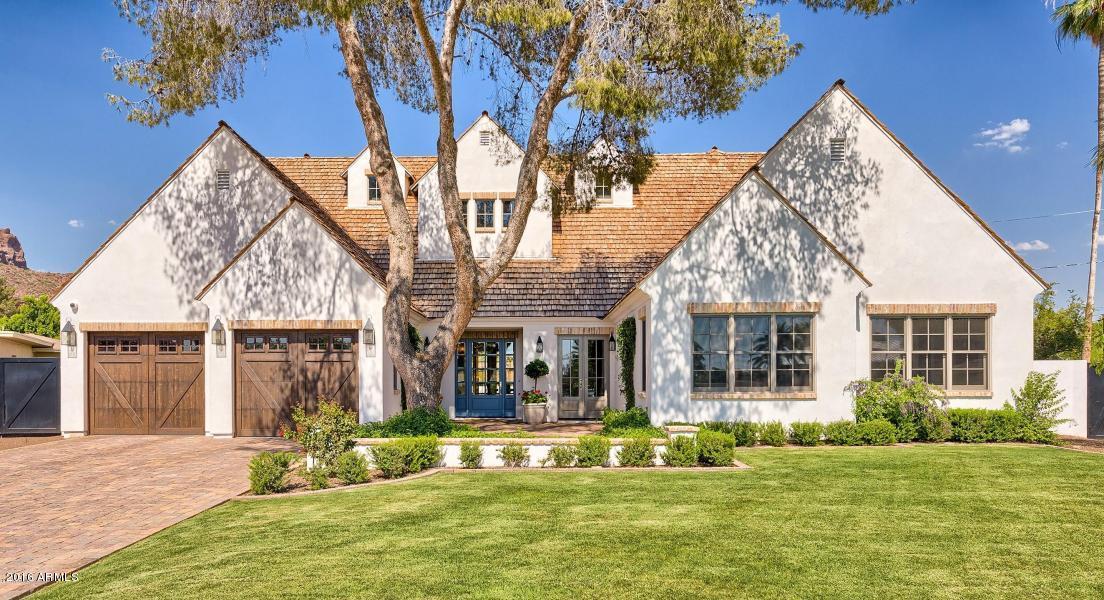
About Arcadia
Stretching from 44th Street east to the Scottsdale border, between Indian School and Camelback Roads, Arcadia is consistently cited as home to the most expensive residential real estate in the city of Phoenix. It is a neighborhood defined by contradiction in the best possible way: sprawling, mature lots that feel almost rural in their scale, set within minutes of world-class dining, high-end retail, and one of the Southwest’s most iconic mountain backdrops. For buyers searching for Arcadia homes for sale, this is the Phoenix address — the one that combines prestige, lifestyle, natural beauty, and long-term value in a way that simply cannot be replicated anywhere else in the Valley.
History & Development: From Citrus Groves to the City’s Most Coveted Address
Arcadia’s story begins not with residential development, but with agriculture. The land that now encompasses some of Phoenix’s most valuable real estate was, through much of the early twentieth century, devoted to citrus production. The area’s sandy loam soil and reliable access to Salt River Project irrigation water made it exceptional citrus-growing territory, and groves of orange, grapefruit, lemon, and tangerine trees covered these blocks for decades.
As Phoenix expanded eastward in the postwar era, the citrus groves gave way to residential development — but they left an extraordinary legacy. The mature citrus trees that remain on Arcadia lots today are direct descendants of those agricultural plantings, and they are one of the neighborhood’s most beloved and distinctive features. In winter and spring, the scent of citrus blossom drifts through the neighborhood; in season, laden trees hang over fences and into yards, a living reminder of the land’s agricultural past. No other neighborhood in Phoenix has this quality, and it cannot be replicated at any price.
Development of Arcadia accelerated from the 1950s through the 1970s, with a broad range of architectural styles reflecting the tastes and ambitions of successive generations of buyers. Later decades brought extensive renovation, infill construction, and the arrival of the luxury custom-home market that has defined Arcadia real estate in the twenty-first century. Today the neighborhood is a rich layering of eras and architectural expressions, unified by the generous lot sizes and mature landscaping that have always been Arcadia’s defining characteristics.
The Most Expensive Homes in Phoenix
No qualifier is necessary: Arcadia contains the most expensive homes in the city of Phoenix. This is not merely a function of recent market appreciation — it reflects the permanent, structural advantages that have made Arcadia the most desirable residential address in the city for generations.
Those advantages include lot size, maturity of landscaping, proximity to Camelback Mountain, access to top-tier schools, and the concentration of exceptional dining and lifestyle amenities that has made Arcadia the neighborhood of choice for Phoenix’s most accomplished residents. Together, these factors have sustained demand that consistently pushes values beyond any other city of Phoenix neighborhood, cycle after cycle.
Buyers should not expect bargains here. What they should expect — and what Arcadia reliably delivers — is a home in a setting of genuine irreplaceability, with long-term value underpinned by exactly the kind of scarcity and desirability that sustain prices across market conditions. Do not include specific price figures in your budget projections; instead, come prepared to compete, because serious buyers in Arcadia do not find themselves alone.
Camelback Mountain: Phoenix’s Most Dramatic Backdrop
Arcadia’s northern edge meets the base of Camelback Mountain, and the relationship between the neighborhood and the mountain is one of the defining elements of life here. From Camelback Road and the streets immediately adjacent, the mountain rises with dramatic immediacy — its red sandstone ridgeline visible from countless properties, its trails accessible within minutes of nearly every Arcadia home.
Camelback Mountain is the most recognizable natural landmark in the Phoenix metropolitan area and one of the most hiked urban mountains in the United States. Its two primary trails — the Echo Canyon Trail on the western face and the Cholla Trail on the eastern — draw hikers from across the Valley and from around the world. For Arcadia residents, those trails are not a destination requiring a commute; they are a neighbor. Early morning hikes before work, evening ascents in the cooler months, and weekend scrambles with visiting friends and family are simply part of the Arcadia lifestyle.
The mountain also shapes the neighborhood’s microclimatic character. Its mass provides wind shadow, its rock face retains heat differently than the surrounding desert, and its presence creates the kind of dramatic evening light — the mountain shifting from ochre to rose to deep purple at sunset — that never loses its appeal, no matter how many times you have seen it. Properties with direct Camelback Mountain views command a meaningful premium even within Arcadia, reflecting how deeply buyers value that particular luxury.
Arcadia’s Outdoor Lifestyle
Life in Arcadia skews outdoors. The neighborhood’s large lots, mature tree canopy, and mountain proximity combine with Phoenix’s extended seasons of comfortable weather to create a lifestyle oriented around the yard, the trail, and the street in a way that distinguishes Arcadia from virtually every other Phoenix address.
Swimming pools are nearly universal on Arcadia lots, and many properties feature extensive outdoor living areas — covered patios, outdoor kitchens, and mature shade trees that make outdoor entertaining genuinely comfortable for much of the year. The Arizona Canal forms the neighborhood’s northern boundary, and its paved multi-use path is a beloved resource for cyclists, joggers, and walkers who use it year-round. The canal path connects Arcadia to the broader Scottsdale system and provides miles of scenic, car-free movement through the urban landscape.
The combination of trail access, canal path, pool culture, and large-lot outdoor living creates an active, outdoor-oriented community that draws buyers who want to live well in Arizona rather than merely endure it.
Architectural Styles: A Layered and Eclectic Collection
Unlike Phoenix’s historic districts, where architectural consistency is protected by preservation overlay, Arcadia’s architecture is wonderfully varied — a reflection of its development across multiple decades and its ongoing reinvention by renovation and new construction. Buyers searching for Arcadia homes will encounter a genuinely eclectic range of styles:
- Mid-Century Ranch — The original backbone of Arcadia’s residential stock, these single-story homes reflect the postwar Arizona lifestyle: wide eaves, deep setbacks, indoor-outdoor flow, and a settled, horizontal quality that sits beautifully on large lots beneath mature trees. Many of the most distinguished examples have been meticulously restored or sensitively updated, with original terrazzo floors, clerestory windows, and period hardware given new life.
- Red-Brick Ranch Estates — A signature Arcadia subtype, the red-brick ranch commands particular affection and consistently strong demand. These homes project a timeless, substantial quality — the brick exteriors age magnificently, the proportions feel generous without ostentation, and the combination of brick and mature citrus landscaping is a visual signature that is immediately recognizable as Arcadia.
- Spanish Colonial Revival — Stucco exteriors, barrel tile roofs, arched entryways, and private courtyards bring the Spanish Colonial tradition to Arcadia lots, where the mature landscaping and mountain backdrop provide a magnificent setting for this classically Arizona style.
- Contemporary and Modern Custom — The last two decades have seen significant custom construction in Arcadia, with architects and builders delivering striking modern residences on the neighborhood’s generous lots. Clean geometry, indoor-outdoor integration, resort-style pools, and high-specification finishes characterize these homes, which draw buyers who want luxury new construction in an established, irreplaceable neighborhood setting.
- Transitional Luxury — A broad and popular category that blends traditional massing and materiality with contemporary interiors — open floor plans, chef’s kitchens, spa-caliber primary suites, and whole-home technology — transitional homes represent much of the renovation-and-rebuild activity that has transformed Arcadia’s housing stock over the past fifteen years.
Lot Sizes and the Arcadia Scale
What sets Arcadia real estate apart from nearly every other established Phoenix neighborhood is the size of the land. Arcadia lots are large by any urban standard — quarter-acre, half-acre, and even larger parcels are common throughout the neighborhood — and that generosity of scale shapes everything about the Arcadia experience: the sense of privacy, the room for mature landscaping and citrus trees, the space for pools and sport courts and detached guest structures, the quiet that comes from genuine setback.
These lots cannot be manufactured. They exist because Arcadia was developed on agricultural land at a moment when the city was still expanding and land was still plentiful. Today, within the urban footprint of Phoenix, that kind of lot size is essentially unavailable except in Arcadia and a handful of adjoining areas. It is one of the most fundamental reasons why Arcadia home values have maintained their position at the top of the Phoenix market regardless of broader economic conditions.
The Arcadia Vibe: Restaurants, Boutiques, and a Neighborhood with Its Own Identity
Arcadia has a cultural identity that is distinct, recognizable, and deeply appealing. The stretch of Camelback Road between 40th Street and 56th Street — and the streets immediately adjacent — has evolved into one of the most vibrant dining and retail corridors in the entire Valley, drawing residents and visitors from across metropolitan Phoenix.
The Arcadia restaurant scene is extraordinary by any standard. A concentration of independently owned, chef-driven restaurants has made this corridor a destination for serious food lovers, with a range that spans casual neighborhood favorites, sophisticated farm-to-table dining rooms, buzzy brunch spots that generate lines on weekend mornings, and everything in between. The dining scene’s independence — the relative scarcity of chain restaurants, the prevalence of owner-operated kitchens — gives it an authenticity and a sense of curation that residents genuinely prize.
Boutique retail, fitness studios, specialty grocers, and a succession of inviting coffee shops complete the picture of a neighborhood that has achieved that rare urban quality: a genuinely walkable, vibrant local scene within a residential setting that is quiet, private, and beautifully landscaped. On a weekend morning in Arcadia, the sidewalks along the retail corridor fill with neighbors on foot and on bike, the kind of spontaneous street life that feels organic rather than engineered.
Schools
Arcadia sits within the Scottsdale Unified School District for much of its eastern extent and the Phoenix Elementary School District and Balsz Elementary School District for other portions — boundaries vary by specific street address. The Arcadia High School attendance area has long been considered one of the most desirable public school assignments in the Phoenix metro. Buyers with school-age children should verify current attendance boundaries based on their specific property of interest, as district lines in this area require careful attention.
The concentration of excellent schools, combined with the neighborhood’s outdoor lifestyle, large lots, and exceptional dining scene, makes Arcadia particularly compelling for families relocating from other major markets who are accustomed to living in established, amenity-rich communities.
Proximity: Everything, Minutes Away
Despite its residential calm, Arcadia’s positioning within the broader metro is exceptional:
- Camelback Mountain — trailheads at the neighborhood’s doorstep
- The Arizona Canal multi-use path — immediately accessible along the northern edge
- Old Town Scottsdale — minutes east, with premier dining, galleries, and nightlife
- The Biltmore Fashion Park — a short drive west, with luxury retail and dining
- Phoenix Sky Harbor International Airport — approximately ten minutes by car
- Downtown Phoenix — accessible via the Camelback corridor, approximately fifteen minutes
- The Camelback Corridor — immediate access to one of the Valley’s premier commercial addresses
- Paradise Valley — adjacent to the northeast, offering additional luxury dining and resort amenities
This combination — residential tranquility, outdoor access, neighborhood dining culture, and proximity to both the city’s core and its most prestigious suburban communities — is why Arcadia real estate continues to attract buyers from across the Valley and from out of state.
What Draws Buyers to Arcadia
Buyers come to Arcadia from across Arizona and from major markets around the country, and they come for reasons that are consistent across demographics and price points.
The lots. The mature citrus trees. The mountain. The sense of space and established beauty that takes generations to create and cannot be purchased into existence in a new master-planned community. These are buyers who have looked at what’s available across the Valley and concluded — correctly — that nothing else offers the same combination of scale, maturity, location, and lifestyle.
The dining and lifestyle scene. Arcadia’s restaurant corridor is genuinely exceptional, and for buyers who prioritize walking distance to great coffee, chef-driven dinners, and a vibrant neighborhood streetscape, it is a powerful draw.
The schools and the family environment. Large lots mean room for children to run, pools to swim in, and yards to grow up in. Desirable school assignments and a neighborhood culture that values outdoor living and community make Arcadia particularly compelling for families.
The prestige and the long-term value proposition. Arcadia has been the most expensive neighborhood in Phoenix for decades, and the structural factors that underpin that position — irreplaceable lots, mountain proximity, mature landscaping, school desirability, dining and lifestyle amenity — are not going away. Buyers who acquire in Arcadia consistently find that the neighborhood rewards patience and commitment.
Thinking About Buying in Arcadia?
The Arcadia real estate market moves quickly, and the most desirable properties attract serious, prepared buyers from the moment they hit the market. If you are considering Arcadia, working with an agent who knows this neighborhood thoroughly is essential. I have guided buyers and sellers through Arcadia’s market at every price point and can help you understand what is available right now, what constitutes true value, and how to position yourself to succeed when the right home becomes available.