

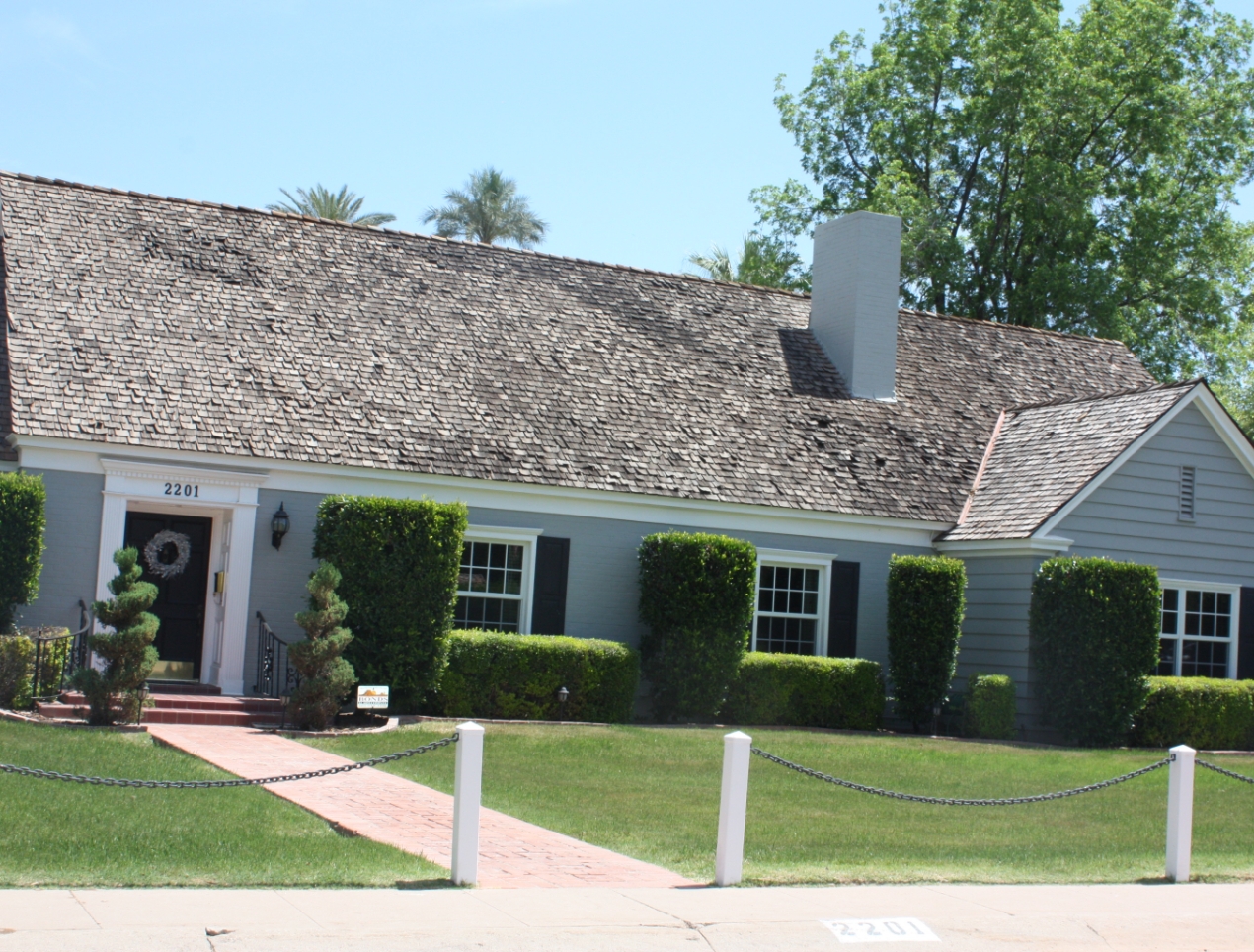
About the Alvarado Historic District
Bounded by Central Avenue and 3rd Street, between Palm Lane and Oak Street, the Alvarado Historic District is one of the most intimate and architecturally distinguished neighborhoods in all of Central Phoenix. With approximately 30 homes arranged along narrow, olive- and palm-lined streets, Alvarado is a quiet enclave of exceptional character — a place where grand Period Revival residences sit beneath a mature tree canopy that has shaded these blocks for nearly a century.
Alvarado is also home to one of the American Southwest’s most celebrated cultural institutions: the internationally renowned Heard Museum, whose world-class collection of American Indian art and culture draws visitors from across the globe. For buyers searching for historic homes in Alvarado Phoenix, this combination of architectural prestige, cultural significance, and central location is simply unmatched in the Phoenix market.
History & Origins
The area now known as Alvarado takes its name from the historic Hotel Alvarado in Albuquerque, New Mexico — itself named after Hernando de Alvarado, a Spanish explorer who accompanied Coronado through the Southwest in the 1540s. The neighborhood was originally platted and developed in the 1920s and early 1930s, during a period when Phoenix was growing rapidly northward along Central Avenue, and wealthy residents were seeking prestigious addresses set apart from the bustle of downtown.
Before it was formally recognized as the Alvarado Historic District, the neighborhood was widely known as Los Olivos — a nod to the striking olive trees that were planted along its narrow streets at the time of development. Those original olives, along with towering palms, remain defining features of the streetscape today. They create a shaded, almost Mediterranean atmosphere that feels genuinely rare in the Arizona desert and gives Alvarado its unmistakable sense of arrival.
Because of its small size — just a few dozen homes — Alvarado was always conceived as an exclusive address. The lots are larger than those found in most surrounding historic neighborhoods, the homes are grander in scale, and the overall presentation is one of deliberate refinement. For generations, Alvarado has attracted Phoenix’s business leaders, civic figures, and culturally engaged residents who prize privacy, architecture, and proximity to the city’s best amenities.
Architectural Styles: A Showcase of Period Revival Grandeur
What makes the Alvarado Historic District Phoenix so architecturally compelling is the concentration of high-quality Period Revival construction in a remarkably small area. Unlike larger historic districts where architectural quality varies block by block, Alvarado’s compact footprint means that nearly every home is a statement piece. The dominant styles reflect the broad stylistic vocabulary of 1920s and 1930s American residential architecture at its most ambitious:
- Spanish Colonial Revival — The most prevalent style in Alvarado, these homes feature stucco exteriors, red or barrel clay tile roofs, arched entryways, wrought-iron hardware, and decorative tile work. Many include interior courtyards or loggia that blur the line between indoor and outdoor living — a sensibility perfectly suited to Arizona’s climate.
- American Colonial Revival — Symmetrical, formal facades with columned entries, shuttered windows, and classical detailing bring an East Coast elegance to the desert. Several of Alvarado’s largest homes fall into this category, with generous proportions and refined millwork throughout.
- Elizabethan and Tudor Revival — Steeply pitched rooflines, decorative half-timbering, leaded glass windows, and robust masonry chimneys give these homes a distinctly romantic, Old English character that remains deeply appealing to buyers who want a home with genuine visual drama.
- Georgian Revival — Brick or stucco exteriors, hipped rooflines, and classically balanced compositions define Alvarado’s Georgian examples — homes that project quiet authority and age beautifully.
- Ranch Style — A handful of later homes reflect the mid-century Ranch aesthetic, with single-story footprints, wide eaves, and indoor-outdoor flow that reflects the postwar Arizona lifestyle.
Across all of these styles, the craftsmanship evident in Alvarado’s original construction is exceptional. Original hardwood floors, plaster walls, hand-laid tile, vintage hardware, and custom millwork are common features — the kind of built-in quality that simply cannot be replicated at any price in new construction.
The Heard Museum: A World-Class Cultural Landmark at Your Doorstep
No discussion of the Alvarado neighborhood would be complete without acknowledging the Heard Museum, which sits on the district’s western edge at Central Avenue. Founded in 1929 — the same era in which Alvarado’s homes were being built — the Heard is recognized internationally as one of the premier institutions dedicated to the art, history, and culture of American Indian peoples.
For residents of the Alvarado Historic District, the Heard is more than a nearby attraction — it is a neighborhood anchor that contributes directly to the area’s cultural prestige and pedestrian vitality. Museum members can walk to world-class exhibitions, lectures, performances, and events. The Heard’s beautifully maintained grounds, annual Indian Fair & Market, and rotating gallery exhibitions make it a year-round resource that enriches daily life in the neighborhood in ways that no other Phoenix address can offer.
Olive Trees, Palms & the Character of the Streets
One of the most immediately striking things about the Alvarado Historic District is the streetscape itself. The narrow, intimate streets — scaled for an era before the automobile dominated — are flanked by mature olive trees and palms that have grown into a genuine canopy over the decades. Unlike the broad arterials and sun-baked asphalt that characterize so much of modern Phoenix, Alvarado’s streets feel cool, shaded, and unhurried.
This canopy is not accidental. The original developers of Los Olivos planted these trees with intention, understanding that mature landscaping would be the defining feature of a truly special neighborhood. Nearly a century later, their investment has paid off magnificently. The combination of the olive trees’ silver-green foliage, the vertical drama of the palms, and the Period Revival facades behind them creates a streetscape that photographers, architects, and preservation advocates consistently cite as among the most visually beautiful in Phoenix.
Front setbacks are generous, giving each home room to breathe and ensuring that the landscaping reads as an integral part of the composition. Many properties feature professionally maintained grounds with additional mature trees, flowering shrubs, and period-appropriate plantings that amplify the neighborhood’s sense of timeless elegance.
Lot Sizes, Home Scale & What Buyers Can Expect
Alvarado’s approximately 30 homes sit on larger-than-average lots for Central Phoenix — a direct reflection of the neighborhood’s original conception as a prestigious, low-density enclave. Where many surrounding historic districts feature homes on 6,000–7,000 square foot lots, Alvarado properties routinely offer significantly more land, providing genuine privacy, room for pools and gardens, and a sense of spaciousness that is increasingly rare this close to central Phoenix.
The homes themselves are typically larger in square footage than those found in neighboring districts. Formal living and dining rooms, multiple bedrooms with original bath configurations, generous kitchens (many updated over the decades while retaining period character), and in many cases secondary structures such as guest houses or garages with apartment space above are common. These are homes built for gracious living, and they show it in every room.
Because of the lot sizes, the architectural quality, and the sheer scarcity of inventory — with only around 30 homes in the entire district — Alvarado is consistently one of the most expensive historic districts in Central Phoenix. When a home becomes available here, it tends to attract serious buyers quickly. Those who wait for the right Alvarado property and move decisively when it appears are rarely disappointed.
Proximity to Amenities & Central Phoenix Lifestyle
Despite its quiet, residential character, the Alvarado Historic District is superbly positioned within the broader Central Phoenix urban fabric. Central Avenue runs along the western boundary of the district, providing immediate access to the Valley Metro Light Rail and the full range of dining, retail, and cultural amenities that have made Central Avenue one of Phoenix’s most vibrant corridors.
Key points of proximity include:
- The Heard Museum — steps from the district’s western edge
- Phoenix Art Museum — less than a mile north on Central Avenue
- Uptown Phoenix dining and retail — immediate neighborhood context
- The Camelback Corridor — minutes by car for premier shopping and restaurants
- Downtown Phoenix and ASU’s downtown campus — accessible via Light Rail
- Roosevelt Row arts district — a short drive or bike ride south
- Banner Health medical campus — nearby on Central Avenue
This combination of walkable cultural resources and easy access to the broader metro area gives Alvarado residents the best of both worlds: a serene, architecturally magnificent neighborhood that never feels disconnected from the energy of the city.
Why Alvarado Stands Apart Among Central Phoenix Historic Districts
Among all of the Central Phoenix historic neighborhoods, Alvarado occupies a unique position. It is not the largest historic district — Willo covers far more acreage and many more homes. It is not the most eclectic — Coronado and Medlock Place offer wider stylistic variety. What Alvarado offers instead is an almost singular concentration of architectural quality, historical prestige, and natural beauty in one of the smallest and most exclusive footprints in Phoenix.
The combination of factors that define Alvarado is genuinely difficult to replicate:
- Scarcity — Roughly 30 homes in the entire district means inventory is extraordinarily limited, which historically sustains and grows values over time.
- Scale — Larger homes on larger lots, in an era of increasingly constrained urban land, represent a rare find.
- The Heard Museum — No other Phoenix residential neighborhood has a world-class cultural institution as a literal neighbor.
- The tree canopy — The original olive and palm plantings have matured into one of the most beautiful streetscapes in the desert Southwest.
- Architectural integrity — The high concentration of well-preserved, high-quality Period Revival construction makes Alvarado a genuine architectural treasure.
- Location — Central Avenue access, Light Rail proximity, and easy reach of both uptown and downtown Phoenix amenities.
For buyers who prioritize architecture, history, cultural richness, and long-term value in a small, cohesive community, Alvarado Historic District represents the highest expression of what Central Phoenix historic living can be.
Thinking About Buying in Alvarado?
Given Alvarado’s small inventory and strong buyer demand, working with an agent who knows the neighborhood deeply — and who can alert you to opportunities before or as they hit the market — is not just helpful, it is essential. I have been working with buyers and sellers in Central Phoenix historic neighborhoods for years, and Alvarado is a district I know intimately. If you are serious about finding a home here, I would love to talk through what the market looks like right now and what your best path forward might be.