

About the Phoenix Country Club Neighborhood
Bounded by 7th Street and 12th Street, between Thomas Road and Osborn Road, the Phoenix Country Club neighborhood is one of the most exclusive and storied residential enclaves in all of Central Phoenix. Developed primarily during the 1930s and 1940s — with a handful of exceptional homes from earlier decades — this intimate community of approximately 100 residences is defined by its relationship to one of the oldest and most distinguished private clubs in Arizona: the Phoenix Country Club, whose championship golf course forms the green heart of the entire neighborhood.
For those searching for Phoenix Country Club homes, this is a world unto itself. Unlike any other area in Central Phoenix, the neighborhood wraps directly around a private golf course and club, giving residents a daily sense of space, greenery, and prestige that no amount of urban landscaping can replicate. The result is a community where luxury and lifestyle converge — where architecturally significant historic homes sit on generous lots overlooking fairways, and where the social fabric of the neighborhood has been woven together, generation after generation, by the shared anchor of the club itself.
History & Origins: A Neighborhood Built Around a Club
The story of the Phoenix Country Club neighborhood begins with the club, because it was the club — not a developer’s plat map — that gave this enclave its reason for being.
The Phoenix Country Club was founded in 1900, making it one of the oldest private country clubs in Arizona and among the earliest in the entire American Southwest. At the dawn of the twentieth century, Phoenix was still a rough-hewn desert outpost of fewer than 5,000 souls, and the founding of a country club in those circumstances was an act of genuine civic optimism — a declaration that Phoenix intended to grow into a city of consequence, with the cultural and social institutions to match.
The club’s original golf course was laid out in the early years of the twentieth century on land that was then at the far northeastern edge of the city — open desert and citrus groves stretching toward the mountains. Over the subsequent decades, Phoenix grew rapidly around it, and the country club’s grounds became increasingly valuable real estate. By the late 1920s and through the 1930s, as Phoenix’s professional and merchant class was consolidating wealth and seeking prestigious home addresses, the land immediately surrounding the golf course was developed into two distinct residential enclaves: Country Club Place, accessed off 7th Street and Thomas Road, and Country Club Manor, a gated community accessed from 12th Street and Osborn Road.
These were never meant to be ordinary neighborhoods. The homes built here were substantial residences commissioned by Phoenix’s civic leaders, physicians, attorneys, business owners, and their families — people who wanted permanence, architecture, privacy, and proximity to the social life of the club. The resulting community has retained that character ever since, passing through the hands of successive generations of Phoenix’s most accomplished residents while maintaining a sense of exclusivity that feels genuinely timeless.
The Phoenix Country Club: Arizona’s Most Storied Private Club
No discussion of this neighborhood would be complete — or even particularly honest — without dwelling at length on the Phoenix Country Club itself, because the club is not merely an amenity adjacent to the neighborhood. It is the neighborhood’s defining feature, its organizing principle, and the source of much of what makes living here so singular.
A Championship Golf Course
The Phoenix Country Club golf course is one of the oldest operating courses in Arizona, with roots stretching back to the club’s founding in 1900. The course has been refined and redesigned over the decades, but its essential character remains that of a classic, tree-lined parkland layout — a rarity in the desert Southwest, where most courses work with the natural arid landscape rather than against it. The mature trees that line the fairways of the Phoenix Country Club course have grown for generations, creating a green, shaded environment that offers a genuine respite from the Arizona sun and a visual drama that cannot be rushed or manufactured.
Playing the course at Phoenix Country Club is an experience that connects members to over a century of Arizona golf history. The layout rewards strategic thinking and shotmaking, and its mature condition — the result of decades of careful stewardship — makes it among the most enjoyable parkland rounds available in Central Phoenix. For residents of the surrounding neighborhood, the view from their properties across the fairways and greens is a daily reminder of what makes this address unlike any other in the city.
Club Amenities and Social Scene
Beyond golf, the Phoenix Country Club offers a full complement of amenities that have made it a center of Phoenix social life for more than a century. The clubhouse — an elegant, architecturally distinguished building at the heart of the grounds — hosts a full-service dining room, private event spaces, and the kind of gracious hospitality that members expect from a club of this caliber.
Tennis courts, swimming facilities, and a year-round calendar of member events ensure that the club is a living, active institution rather than a mere backdrop. Formal dinners, holiday galas, golf tournaments, and casual member gatherings throughout the year create a social fabric that binds the community together in ways that go well beyond shared geography. For families, the club’s junior programs in golf and tennis have introduced generations of Phoenix children to lifetime sports in an environment that prizes good sportsmanship and genuine enjoyment.
This social dimension is not incidental — it is, for many residents, the primary reason they chose the Phoenix Country Club neighborhood in the first place. The ability to walk to a world-class club, to know your neighbors through decades of shared membership, and to raise children within a community defined by mutual interest and long acquaintance is a form of lifestyle that simply cannot be replicated in a newer development or a more anonymous urban setting.
Architectural Styles: A Curated Collection of Mid-Century Elegance
The homes of the Phoenix Country Club neighborhood were built primarily between the mid-1920s and the late 1940s, a period that represents the full flowering of Period Revival residential architecture in America. Because the neighborhood was developed specifically for an affluent clientele, the architectural quality here is consistently high — these were not speculative homes built to a budget, but individually commissioned residences designed to make a statement and built to endure.
The dominant architectural styles in the neighborhood reflect the broad vocabulary of interwar American residential design at its most ambitious:
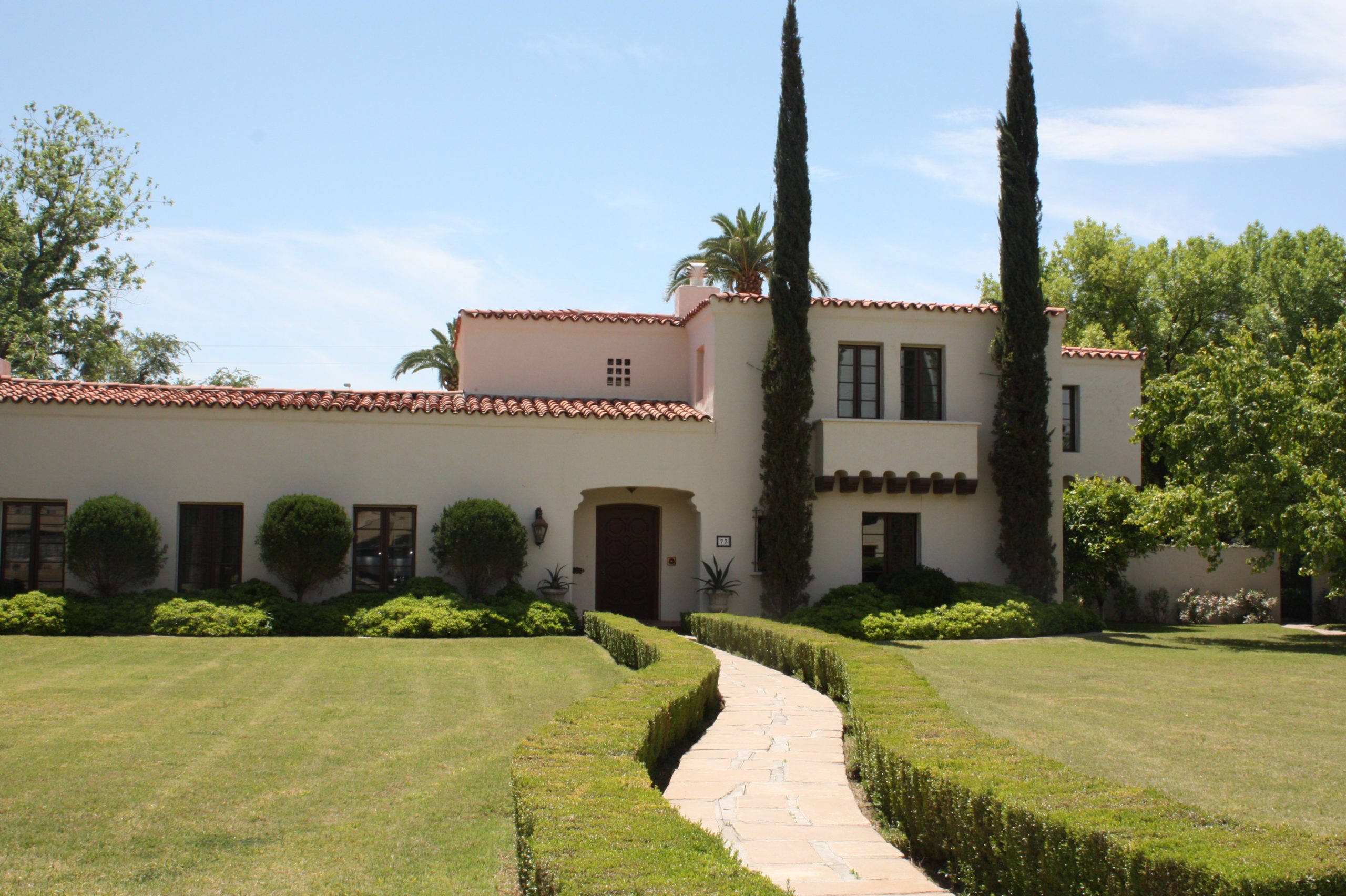
- Spanish Colonial Revival — The most prevalent style in the neighborhood, these homes feature creamy stucco exteriors, red and barrel clay tile roofs, arched entryways and windows, wrought-iron hardware, and decorative tile work that draws on the Spanish Colonial tradition of the American Southwest. Many include private courtyards, loggias, and shaded outdoor living areas — a design sensibility perfectly suited to the Arizona climate and beautifully compatible with views across the adjacent golf course.
- Tudor Revival — Steeply pitched rooflines, decorative half-timbering, leaded glass windows, and substantial masonry chimneys give these homes a deeply romantic Old English character. The Phoenix Country Club neighborhood’s Tudor examples tend to be larger and more elaborately detailed than those found in many surrounding historic districts, reflecting the affluent buyers for whom they were built.
- Ranch Style — A number of homes in the neighborhood, particularly those built in the late 1930s and 1940s, reflect the early Ranch aesthetic — sprawling, single-story floor plans that embrace indoor-outdoor living and a distinctly Southwestern ease. These homes age particularly well on golf-adjacent lots, where their low profiles and wide eaves feel architecturally honest and deeply livable.
- Mid-Century Modern — A handful of later homes incorporate the clean lines, flat or low-pitched rooflines, and integration with the landscape that characterize the best Mid-Century Modern residential design. These properties offer a compelling contrast to the Period Revival majority and have attracted increasing interest from buyers who appreciate the style’s timeless quality.
- American Colonial Revival — Symmetrical facades, columned entries, shuttered windows, and classically balanced compositions bring an East Coast formality to the desert. These homes project quiet authority and have aged gracefully into their mature landscape settings.
Across all of these styles, the craftsmanship evident in the neighborhood’s original construction is exceptional. Original hardwood floors, plaster walls, hand-laid ceramic tile, vintage hardware, and custom millwork are common throughout the neighborhood — the kind of built-in quality and material honesty that cannot be reproduced in new construction and that gives these homes a warmth and character buyers feel the moment they step inside.
Two Distinct Communities: Country Club Place and Country Club Manor
The Phoenix Country Club neighborhood is organized into two distinct residential sections, each with its own character and access point.
Country Club Place — Accessed off 7th Street and Thomas Road, this section of approximately 43 homes sits along the western and northern edges of the golf course. Homes here are set on generous lots with golf course views, and the neighborhood’s tree-lined streets give it a gracious, unhurried quality. Country Club Place feels open and accessible — a historic residential neighborhood in the finest Central Phoenix tradition, connected to the street grid while still retaining a strong sense of enclave.
Country Club Manor — A gated community of approximately 56 homes accessed from 12th Street and Osborn Road, Country Club Manor offers an additional layer of privacy and security. The gated format makes this section particularly appealing to buyers who prioritize seclusion, and the larger lots and more substantial homes here reinforce the Manor’s reputation as one of the most private and sought-after addresses in Central Phoenix.
Together, the two sections comprise a neighborhood of roughly 100 homes — a number small enough to create genuine community, and exclusive enough to ensure that the neighborhood never feels crowded or anonymous.
Tree-Lined Streets, Mature Landscaping & the Luxury of Space
What immediately strikes visitors to the Phoenix Country Club neighborhood — beyond the golf course itself — is the extraordinary maturity of the landscaping. The trees that line these streets were planted generations ago, and they have grown into a genuine canopy that shades sidewalks, frames homes, and creates a cool, dappled environment that feels almost impossibly lush by Phoenix standards.
Mature mesquite, olive, citrus, and shade trees define the streetscape, supplemented by decades of individual homeowner investment in their own gardens. Front yards are generous by Central Phoenix standards, and many feature professionally maintained grounds with mature palms, flowering shrubs, hedgerows, and period-appropriate plantings that amplify the neighborhood’s atmosphere of cultivated elegance. The combination of the golf course’s expansive green space and the neighborhood’s own mature landscaping gives residents a daily experience of greenery and shade that is genuinely rare in the Sonoran Desert.
Lot sizes throughout the Phoenix Country Club neighborhood are substantially larger than those found in most surrounding Central Phoenix historic districts. These are homes with room to breathe — with space for pools, covered outdoor living areas, mature trees, and private gardens — and that generosity of space is one of the most tangible reasons buyers choose this neighborhood over more densely developed alternatives nearby.
Proximity to Downtown Phoenix & the Central Phoenix Lifestyle
Despite its enclave character, the Phoenix Country Club neighborhood is ideally positioned within the broader Central Phoenix urban fabric. Sitting just over a mile northeast of the Phoenix city center, the neighborhood offers the rare combination of genuine seclusion and immediate urban access that defines the best Central Phoenix addresses.
Key points of proximity include:
- Downtown Phoenix — approximately one mile to the southwest, accessible by car in minutes or by bicycle along shaded neighborhood streets
- Valley Metro Light Rail — Central Avenue and 7th Street stations provide car-free access to downtown Phoenix, ASU’s downtown campus, Midtown, Tempe, and points throughout the Valley
- Midtown Phoenix dining and retail corridor — immediately accessible to the northwest, with a growing range of restaurants, cafés, boutiques, and services along 7th Street and Central Avenue
- The Biltmore Fashion Park — a short drive northeast, offering premier shopping and dining in a beautifully landscaped setting
- The Phoenix Art Museum and Heard Museum — minutes away on Central Avenue, offering world-class exhibitions, lectures, and cultural programming year-round
- Roosevelt Row arts district — a short drive southwest, with galleries, restaurants, and weekend farmers markets that anchor Phoenix’s creative community
- St. Joseph’s Hospital and Medical Center and Banner Health — nearby on Central Avenue, among the finest medical facilities in the Southwest
- Sky Harbor International Airport — approximately ten minutes by car, providing easy access to national and international destinations
The result is a neighborhood that genuinely offers the best of both worlds: a serene, architecturally distinguished setting with mature trees, golf-course views, and the privacy of an exclusive enclave — combined with effortless access to everything that makes Central Phoenix real estate so compelling.
What Draws Buyers to the Phoenix Country Club Neighborhood
Buyers come to the Phoenix Country Club neighborhood from across the Valley and from out of state, drawn by a combination of factors that is genuinely difficult to find anywhere else in Phoenix.
Prestige and history are primary for many. This is one of the oldest and most consistently prestigious residential communities in Arizona. Owning a home here connects a buyer to over a century of Phoenix history — to the civic leaders, entrepreneurs, and families who built the city and chose this neighborhood as their home. That provenance matters, and it is not something that can be manufactured in a newer development.
The country club lifestyle is equally compelling. For buyers who are members — or who intend to become members — of the Phoenix Country Club, the ability to live a short walk from the course, the clubhouse, and the social life of the club is a form of daily luxury that is essentially unavailable anywhere else in Central Phoenix. The integration of neighborhood and club creates a lifestyle that feels genuinely different from any other address in the Valley.
Architectural quality and character draw buyers who have spent years living in newer construction and who are ready for homes with soul — original hardwood floors, plaster walls, hand-laid tilework, and the kind of craftsmanship that reflects an era when quality was not a marketing claim but a builder’s standard.
Space and privacy appeal to buyers who want room — large lots, mature trees, private outdoor areas, and the quiet that comes from living in a small, low-density enclave rather than a dense urban neighborhood.
Long-term value resonates with buyers who understand that a finite number of exceptional homes, in a protected, prestigious setting this close to downtown Phoenix, represents a genuinely scarce asset. The neighborhood’s consistent appeal across generations is itself a form of evidence that the combination of factors it offers is not easily replicated or superseded.
The Luxury of Irreplaceability
The homes of the Phoenix Country Club neighborhood cannot be rebuilt. The trees cannot be replanted and grown to their current scale. The golf course — one of the oldest in Arizona — cannot be moved or reimagined. The neighborhood’s position between downtown Phoenix and the Biltmore corridor, in a low-density enclave that wraps around a private championship course, is simply fixed.
That combination of irreplaceability and quality — historic architecture, golf-course setting, mature landscaping, prestigious social anchor, and Central Phoenix location — is what makes Phoenix Country Club homes for sale so consistently sought after when they come to market, and why the owners who find their way here so rarely want to leave.
Thinking About Buying in the Phoenix Country Club Neighborhood?
Given the neighborhood’s small inventory and strong, consistent buyer demand, working with an agent who knows this community deeply — and who can alert you to opportunities as they emerge — is not just helpful, it is essential. I have been working with buyers and sellers in Central Phoenix historic neighborhoods for years, and the Phoenix Country Club neighborhood is a community I know intimately. If you are serious about finding a home here, I would love to talk through what the market looks like right now and what your best path forward might be.